Program Profile
The B.Sc. programme offers a general specialisation in mechanical engineering and was established in 2015. It provides an interdisciplinary curriculum focusing on sustainability, product design and project management. Courses develop students’ knowledge in mechanics, thermodynamics, fluid mechanics, heat transfer, materials science, dynamics, vibrations, control and computer‑aided design. The programme addresses pressing needs in energy, transportation and health and aspires to become a centre of advanced research, emphasising excellence in teaching, research and service.
Occupational profiles of graduates
Graduates can work in a wide range of sectors, including automotive, aerospace, energy, manufacturing, heating and refrigeration and consultancy. Typical roles involve analysing problems and designing, developing, testing and supervising the manufacture of mechanical and thermal devices such as engines, turbines, power plants and air‑conditioning systems. Graduates also investigate equipment failures, develop prototypes and ensure products meet quality and safety standards.
Qualification awarded
Bachelor of Science (B.Sc.) in Mechanical Engineering
Length of programme
4 years (8 semesters)
Number of credits
240 ECTS credits
Mode of Study
Full time on campus
Read more about the programme
Get detailed information about the programme requirements, courses, credits, and educational objectives as a PDF file.

Program Educational Objectives (PEOs)
Technical Leadership in Regional Industries
Graduates will excel in applying advanced mechanical engineering principles to address complex challenges and drive innovation within the industrial, service, food processing, energy, and oil sectors of Kurdistan.
Sustainable Solutions and Ethical Practice
Graduates will design, implement, and manage engineering solutions that prioritize public health, safety, environmental sustainability, and economic viability, adhering to professional ethics and responsibilities in the local and global context.
Collaborative Professional Development
Graduates will effectively collaborate within diverse teams, communicate complex technical information, and commit to continuous professional development to adapt to evolving technological landscapes and industry demands in the region.
Program Learning Outcomes
- An ability to identify, formulate, and solve complex mechanical engineering problems, particularly those encountered in industrial machinery, energy systems, and infrastructure, by applying principles of engineering, science, and mathematics.
- An ability to apply mechanical engineering design principles to develop and optimize solutions for mechanical systems (e.g., HVAC, power generation, industrial processes, food production machinery), considering performance, efficiency, safety, and relevant socio-economic factors.
- An ability to develop, conduct, and interpret results from appropriate experimentation and simulations for mechanical systems, critically analyzing data to draw valid engineering conclusions.
- An ability to recognize ethical and professional responsibilities in mechanical engineering practice, making informed judgments that consider the impact of engineering solutions on local and global society, economy, and environment, especially within regional industrial contexts.
- An ability to function effectively on multidisciplinary teams, providing leadership, fostering collaboration, and communicating complex technical information clearly to a range of audiences, both within engineering and with non-technical stakeholders.
- An ability to acquire and apply new knowledge and emerging technologies in mechanical engineering, utilizing appropriate learning strategies to adapt to the dynamic needs of the industrial and service sectors.
General Requirement for Completing the Program
Courses
Students are required to obtain a minimum of 222 ECTS credits over the period of 8 semesters.
Graduation Project
The students have to complete a graduation project worth 12 ECTS and present a report to the department and pass an exam.
Internship
Students are required to complete a 6-ECTS internship, typically scheduled in the final semester or upon earning a minimum of 180 ECTS credits.
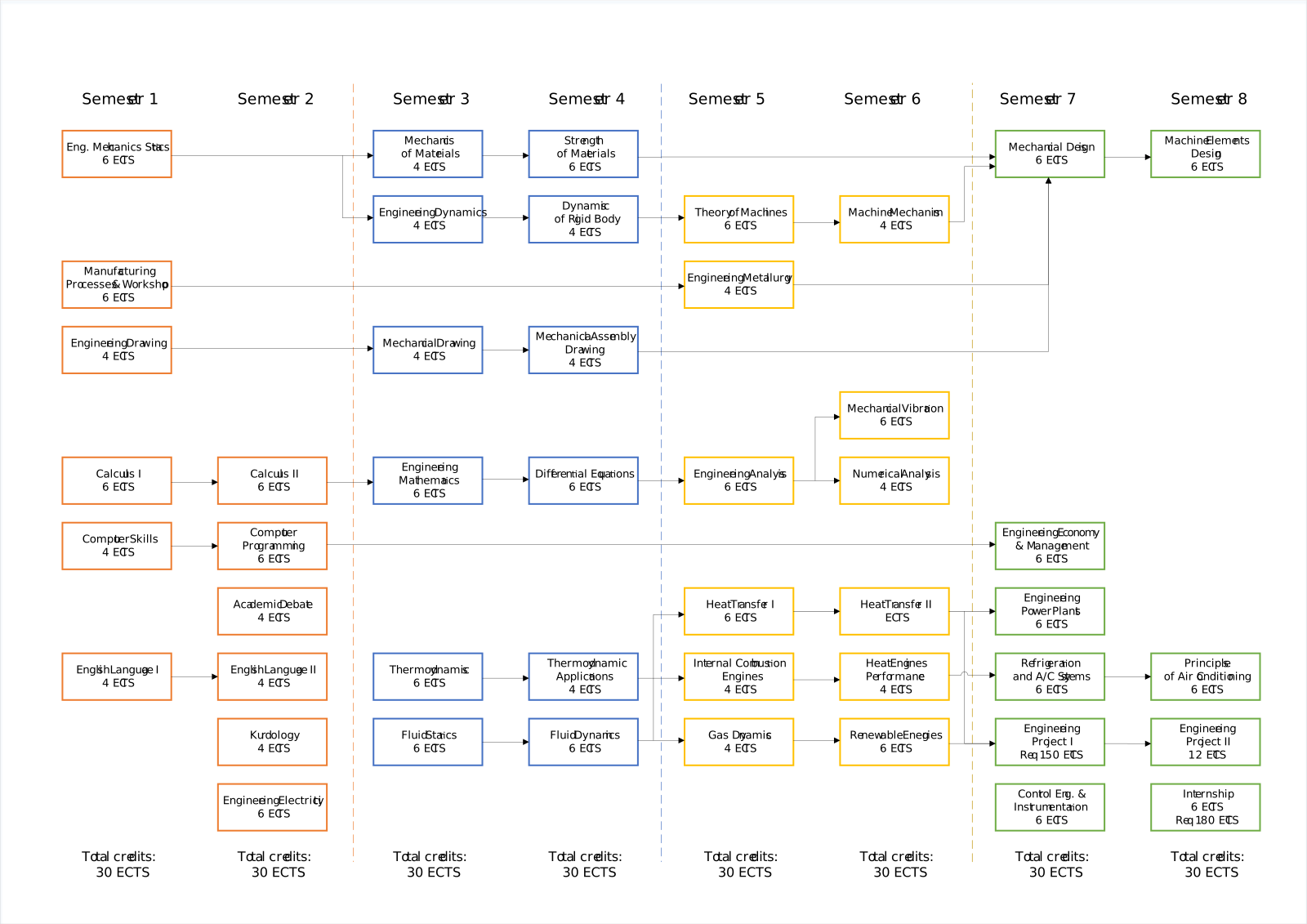
Programme structure diagram with credits
Programme Coordinator
Yearly Timeline
Sept. 1, 2026
⚠️ First year students start around mid-October
⚠️ First year students start exams around 20 of January
July 1, 2027
Check out the full academic calendar on UoD's webstie.
Assistant Professor in Fluid Mechanics/ Computational Fluid Dynamics
Mechanical Engineering
College of Engineering
University of Duhok
Apply to the Programme
Public undergraduate admissions in the KRG region are managed centrally by the Ministry of Higher Education through the online ZankoLine portal (regayzanko.com). After Grade 12 Baccalaureate results are released, high schools provide students with unique login credentials to rank their preferred universities and B.Sc. majors during a 10–14 day registration window. Final placement is automatically determined by the student's Grade 12 average, subject choices, and department capacity.